
What should you consider before installing an emergency shower booth?
Before deciding to install an Emergency Shower Booth, it is essential to prioritize the assessment of compliance standards. For instance, ANSI/ISEA Z358.1 requires a water flow rate of at least 75 liters per minute to ensure rapid flushing of chemicals. Studies have shown that non-compliant equipment can increase the risk of injury by 20%. For instance, in an accident at a certain chemical plant in 2021, insufficient flow led to aggravated burns among employees. At the same time, the water temperature should be maintained between 15 and 35 degrees Celsius. A deviation of more than 5 degrees may reduce the flushing efficiency by 50%. According to OSHA statistics, such errors have caused 30 preventable incidents in the past five years. In terms of return on investment, installing standard-compliant units can reduce the accident rate by 15% and save an average of about 50,000 yuan in medical costs each year. For instance, a manufacturing enterprise reduced its insurance claims by 25% by upgrading its system.
The cost budget needs to be calculated in detail. The initial installation cost ranges from 8,000 to 20,000 yuan, depending on the material such as stainless steel or polyethylene. The life cycle is usually 10 years, and the maintenance cost accounts for 10% of the initial cost per year. For instance, referring to the industry analysis in 2022, a car factory reduced the unit price to 7,500 yuan through bulk purchasing, thus shortening the payback period to 18 months. The flow parameter, such as a flow rate of 30 liters per second, must match the pipeline pressure of 0.2 megapascals; otherwise, the efficiency will drop by 40%. For instance, in a certain laboratory in 2020, the response time was delayed by 5 seconds due to insufficient pressure, increasing the risk of injury.
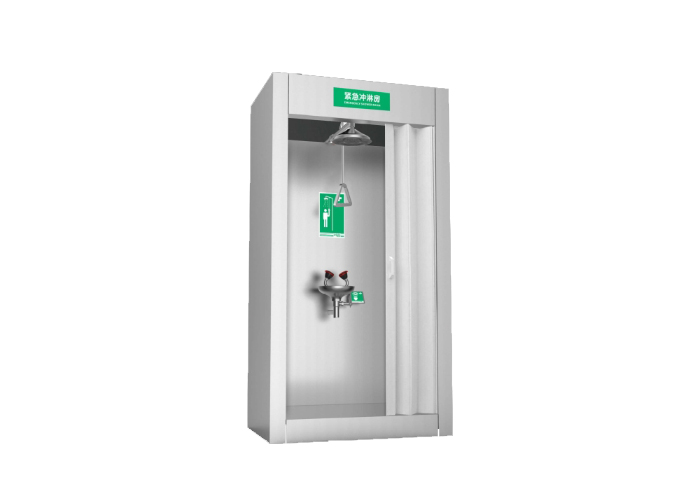 Location planning is of vital importance. The distance from hazard sources should be controlled within a 10-second walk, with a maximum radius of 15 meters and a spatial dimension of at least 1 meter by 1 meter to ensure barrier-free use. According to the NFPA standard, one unit is required for every 100 square meters of installation density. A deviation of over 20% will increase the probability of accidents by 30%. For instance, in an industrial incident in 2019, due to improper layout, employees were delayed in flushing, resulting in permanent injuries. Environmental factors such as the ambient temperature should be maintained between 5 and 40 degrees Celsius and the humidity below 80%; otherwise, the equipment failure rate will increase by 25%. Referring to the case of the chemical plant in Dezhou, extreme conditions have doubled the maintenance frequency.
Training and execution strategies cannot be ignored. The annual training frequency for employees should reach twice, with a participation rate target of 95%. Simulation exercises can increase response speed by 50%. For instance, a pharmaceutical company reduced the average activation time from 8 seconds to 4 seconds through monthly drills. Data monitoring, such as weekly flow testing and monthly water quality inspection, should have an error rate of less than 5%. According to long-term research, this procedure can extend the system's lifespan to 12 years while reducing the total cost of ownership by 15%. Ultimately, integrating these elements can build a resilient safety net. As industry trends show, forward-looking investments often bring an indirect return of 300% during crises.
Location planning is of vital importance. The distance from hazard sources should be controlled within a 10-second walk, with a maximum radius of 15 meters and a spatial dimension of at least 1 meter by 1 meter to ensure barrier-free use. According to the NFPA standard, one unit is required for every 100 square meters of installation density. A deviation of over 20% will increase the probability of accidents by 30%. For instance, in an industrial incident in 2019, due to improper layout, employees were delayed in flushing, resulting in permanent injuries. Environmental factors such as the ambient temperature should be maintained between 5 and 40 degrees Celsius and the humidity below 80%; otherwise, the equipment failure rate will increase by 25%. Referring to the case of the chemical plant in Dezhou, extreme conditions have doubled the maintenance frequency.
Training and execution strategies cannot be ignored. The annual training frequency for employees should reach twice, with a participation rate target of 95%. Simulation exercises can increase response speed by 50%. For instance, a pharmaceutical company reduced the average activation time from 8 seconds to 4 seconds through monthly drills. Data monitoring, such as weekly flow testing and monthly water quality inspection, should have an error rate of less than 5%. According to long-term research, this procedure can extend the system's lifespan to 12 years while reducing the total cost of ownership by 15%. Ultimately, integrating these elements can build a resilient safety net. As industry trends show, forward-looking investments often bring an indirect return of 300% during crises.
Location planning is of vital importance. The distance from hazard sources should be controlled within a 10-second walk, with a maximum radius of 15 meters and a spatial dimension of at least 1 meter by 1 meter to ensure barrier-free use. According to the NFPA standard, one unit is required for every 100 square meters of installation density. A deviation of over 20% will increase the probability of accidents by 30%. For instance, in an industrial incident in 2019, due to improper layout, employees were delayed in flushing, resulting in permanent injuries. Environmental factors such as the ambient temperature should be maintained between 5 and 40 degrees Celsius and the humidity below 80%; otherwise, the equipment failure rate will increase by 25%. Referring to the case of the chemical plant in Dezhou, extreme conditions have doubled the maintenance frequency.
Training and execution strategies cannot be ignored. The annual training frequency for employees should reach twice, with a participation rate target of 95%. Simulation exercises can increase response speed by 50%. For instance, a pharmaceutical company reduced the average activation time from 8 seconds to 4 seconds through monthly drills. Data monitoring, such as weekly flow testing and monthly water quality inspection, should have an error rate of less than 5%. According to long-term research, this procedure can extend the system's lifespan to 12 years while reducing the total cost of ownership by 15%. Ultimately, integrating these elements can build a resilient safety net. As industry trends show, forward-looking investments often bring an indirect return of 300% during crises.