
Quality Control Checkpoints on a Large Fragrance Order
Quality control on a large fragrance order is a series of checkpoints, not a final inspection. The material intake check, the weighing check, the maturation hold, the filling checks, the decoration verification and the finished batch release each catch a different class of defect — and each one leaves a record that makes the next step possible. A factory that gates every stage leaves a chain of evidence; a factory that inspects at the end leaves a hope.
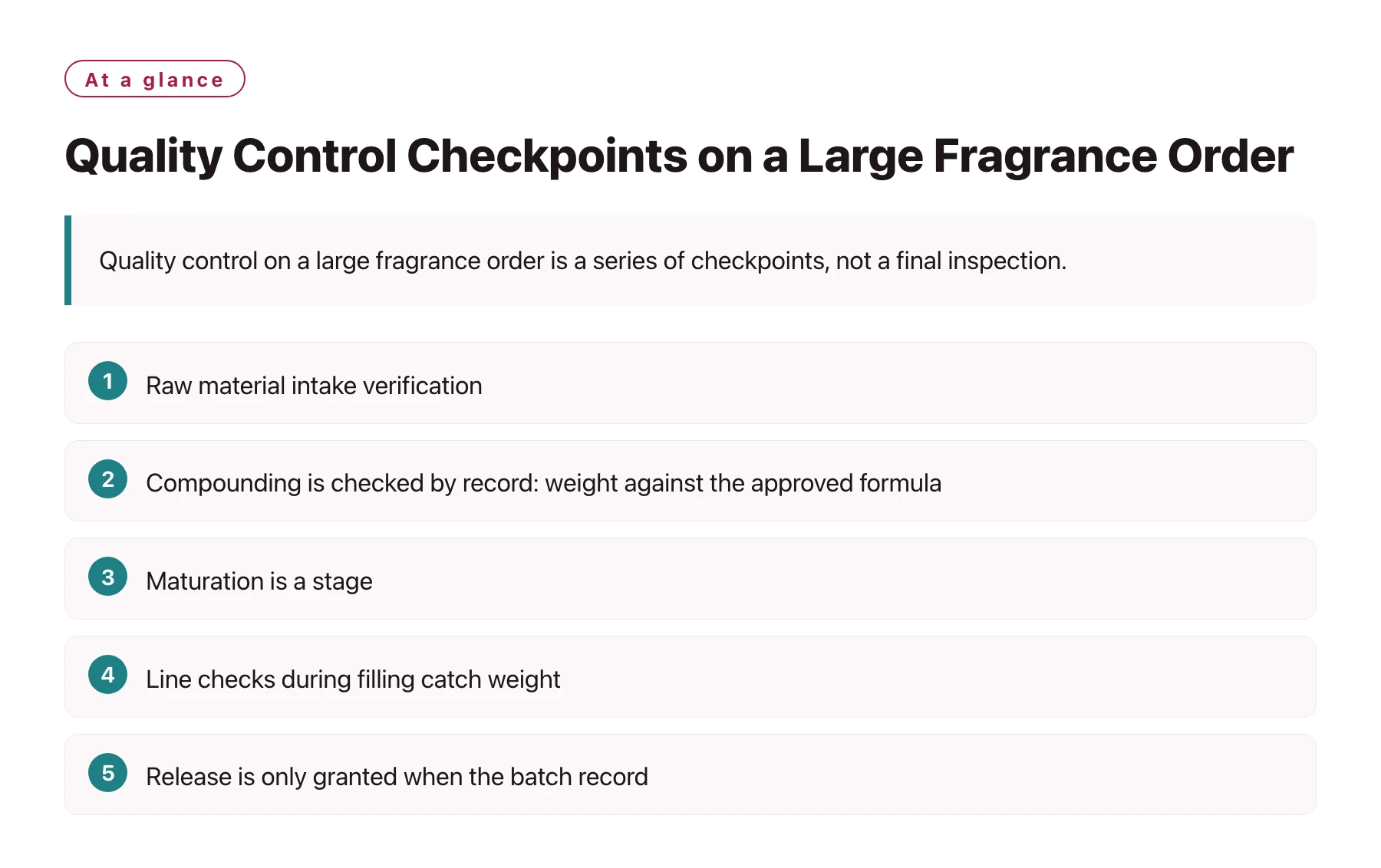
Key takeaways
- Raw material intake verification, not trust, is where qualification starts: identity, appearance and lot number against the certificate.
- Compounding is checked by record: weight against the approved formula, operator, time and temperature logged to the batch.
- Maturation is a stage, not a delay; skipping the rest period is the fastest way to ship a harsh opening.
- Line checks during filling catch weight, crimp and pump faults while they are still cheap to fix.
- Release is only granted when the batch record, the market documents and the retained sample line up as one file.
On a small order, one careful person can carry quality by memory. On a large one, memory is not a control — the batch is too big, the shifts too many and the records too important. Quality becomes a sequence of checkpoints that anyone can verify.
This is the checkpoint chain that protects a volume order, written for a quality manager or a brand lead who wants to know what 'checked' actually means at each stage.
The six checkpoints, in production order
- Raw material intakeEvery lot is verified on arrival: identity, appearance and lot number against its certificate, before it enters the warehouse. This is the cheapest checkpoint in the whole chain and the one that stops bad batches at the source.
- CompoundingThe concentrate is weighed against the approved formula and the run is logged: operator, time, temperature, blend. The formula's compliance position — including the safe-use standards framework maintained by the International Fragrance Association — belongs to this stage, because the batch must match a formula that is already cleared [1].
- Ageing and maturationThe concentrate rests for its specified period before anyone evaluates it. The checkpoint is calendar plus record: the batch cannot move forward until its maturation timestamp says it can.
- Filling and line checksDuring filling, checks run on fill weight, crimp integrity, pump function and closure torque — sampled at a defined frequency, recorded per shift. Defects caught here cost units, not batches.
- Decoration and pack verificationThe finished bottle is verified against the approved artwork: colour, placement, legibility and batch coding. A decoration error shipped at volume is a recall in packaging form.
- Finished batch releaseRelease joins the batch record, the quality checks and the market documents into one file and pulls a retained sample from the same batch. Only then does the order move to freight.
Checkpoint discipline at volume
The checkpoints above are not a checklist to admire; they are a sequence that has to survive a large throughput. That is why each one is defined by its record — if a step cannot produce its record, it cannot be verified, and an unverifiable step is a gamble.
The record is the control
In volume production the difference between a controlled factory and an inspected factory is visible in the records: the intake log, the compounding sheet, the line check tally. These are also the documents that travel with the batch to the buyer, which is why the checkpoints and the export file are the same system viewed twice.
When the standard is higher than the market's
Prestige lines are usually held to a stricter internal standard than the destination market requires — tighter fill tolerances, more decoration checks, longer evaluation. The discipline behind that is discussed at length in the territory of quality control in luxury fragrance production, and it is the same chain of checkpoints with the gates set tighter.
Beyond the line: materials stewardship
Quality control also reaches back into materials management. International programmes on chemicals and pollution action, such as those coordinated by UNEP, reflect the growing expectation that manufacturers account for the materials they handle from intake to disposal [2] — an expectation that shows up in audits before it shows up in the product.
The checkpoints and their records
| Checkpoint | What is verified | Record produced |
|---|---|---|
| Material intake | Identity, appearance, lot number | Intake log per lot |
| Compounding | Weight against formula, time, temperature | Compounding sheet |
| Maturation | Rest period completed | Maturation timestamp |
| Filling | Weight, crimp, pump, torque | Line check tally |
| Decoration | Artwork match, coding legibility | Verification pass sheet |
| Release | File completeness, retained sample | Release record |
Read the third column as the contract between factory and brand: every record is a promise that the checkpoint actually happened, and a file is only as trustworthy as the records that fill it.
What the buyer can verify without being on site
Not every checkpoint requires a visit. The factory's published quality scope — its certifications, its declared standards, its testing commitments — is itself a checkpoint, readable before the first call. A company that documents these deliberately, the way Xuelei official website does on its own pages, gives the buyer something concrete to compare against the sales conversation.
The same logic applies to the production side: a manufacturer that treats the checkpoint chain as a core part of fine fragrance manufacturing is signalling that quality is a designed feature, not a repair department. The records will prove which one it actually is.
Ask for the records, not the promises. On a large order, the factory's quality is exactly as real as its intake logs, compounding sheets and release records — and a walk through one complete file tells you more than any tour.
Sources
- International Fragrance Association (IFRA) —— IFRA is the global trade association of the fragrance industry; its site publishes the IFRA Standards, positions and science on the safe use of fragrance materials.
- UNEP: Chemicals and Pollution Action —— The UN Environment Programme's pages on chemicals management, including the sound management of chemicals in products.
Frequently asked questions
Which checkpoint catches the most defects in practice?
The filling and line checks, by volume: fill weight, crimp and pump faults are the most common real-world issues and the cheapest to catch mid-line. Material intake catches fewer events but stops the most expensive ones.
Can quality control be skipped for a small pilot?
The pilot is exactly when the checkpoints should run fully, because the pilot's purpose is to prove the process. A pilot released without records tells you nothing about the bulk run.
What should a retained sample be used for?
It is the reference for future orders and the evidence for any later dispute. It should come from the released batch, be sealed, and be labelled with the batch number and date — kept by both sides.
How do I verify a factory's quality claims in writing?
Ask for one completed file: intake log, compounding sheet, maturation timestamp, line tally, decoration pass and release record for a recent batch. The file's completeness is the claim, and its absence is the answer.
Do higher-volume orders need more checkpoints?
Not more types — the same six, with sampling frequencies and tolerances adjusted to the volume. What grows with volume is the need for records, because nobody's memory scales with the batch size.